

#19 - Hemispherical Stacks
Deep images, thick fog and eyeballing the near future.
In July 2025, the Antikythera team’s design director Nicolay Boyadjiev approached us to design the visual accompaniment to their upcoming project Hemispherical Stacks. The brief was exquisitely simple: images had to be generated. The use of AI was non-negotiable.
Recent times have been marked by a particular instability for generative systems. The surrounding discourse has expanded faster than any shared framework for use, refusal, or accountability. For many practitioners, maintaining distance has emerged as a provisional response to this imbalance—not as a rejection of the technology itself, but as an attempt to preserve agency in a context where integration increasingly feels less like experimentation and more like enforced adaptation. For others, approaching AI as a potential tool for progressive creative practice has been essential to avoiding stultifying polarization.
At Giga HQ, the past year has been one of intense experimentation with generative AI. Through projects and writing, we have attempted to make sense of this apparently disruptive source and to integrate it into our pipeline.
What made Hemispherical Stacks distinct was that we were not simply asked to incorporate artificial intelligence into an existing workflow. Instead, we were asked to conceptualize generative AI as a condition within which images would already exist: a camera obscura.
In their controversial 2001 essay Secret Knowledge, painter David Hockney and physicist Charles Falco proposed the thesis that optical devices were widely diffused among image-makers of the early modern period (Yes, painters). According to their argument, technologies such as curved mirrors, the camera lucida, and the camera obscura contributed to a sudden acceleration of realism—producing depictions so optically precise that they forced the human eye to recognize, retroactively, how much there is to observe in the world.
If eyeballing the physical world through a lens exponentially increased the amount of gatherable data from the observed subject, the world itself began to take the shape of a dataset. The camera obscura, in this reading, shifted from a mere tool to a site: a place where visual information could be captured, stored, and manipulated.
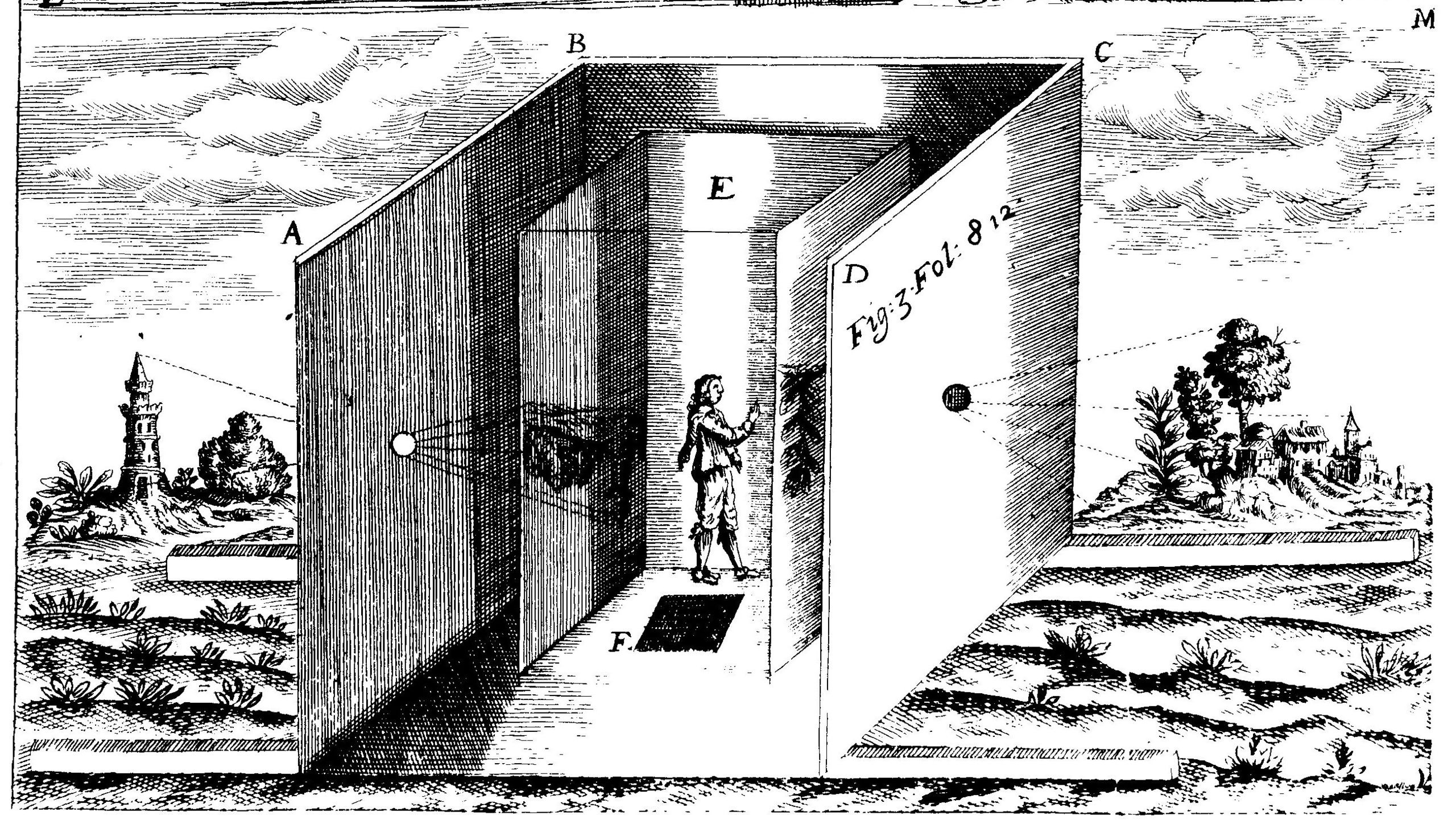
This reconfiguration of the world as “more-data“ prompted us to reflect on AI as a continuum of such process of image acquisition. If lenses and optical devices rendered the eye obsolete for observation, generative systems seems to disrupt our ability to rearrange such vast amount of data into new configurations of meaning.
Within this framework, AI was not positioned as an instrument but as an environment from which visions could be extracted—visions otherwise impossible to eyeball. What we read between the lines was that the task was not to make AI-generated images appear seamless, but to work from within their compromised nature and to render that condition legible.
The Antikythera publication builds on Benjamin Bratton’s concept of The Stack, doing so at a moment when the abstraction of platform logic has hardened into material and geopolitical reality. Planetary computation no longer functions as background infrastructure; it actively reorganizes sovereignty, logistics, and power. The project identifies a transition toward hemispherical stacks, in which influence is increasingly determined by control over data regimes, semiconductor supply chains, orbital systems, and the scale of AI models themselves. These formations do not map cleanly onto national borders, but instead produce gradients of power operating across territories, institutions, and technical layers simultaneously.
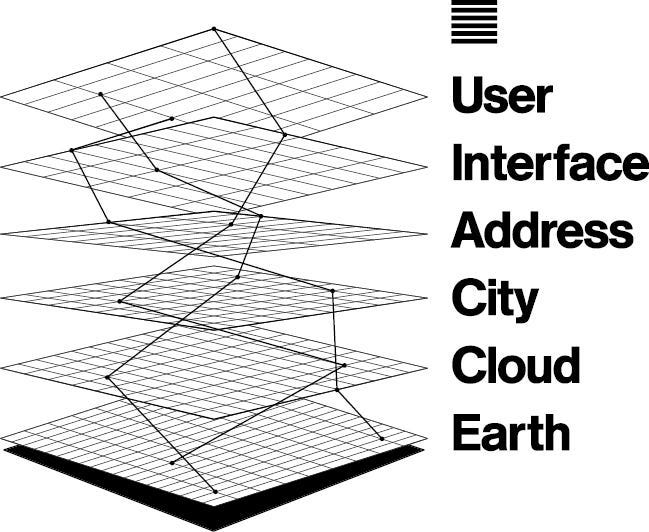
To investigate these dynamics, multiple authors adopt scenario fiction as a methodological device. These texts are not speculative narratives in the conventional sense, nor illustrative futures designed for entertainment. Instead, they function as analytical instruments, combining institutional planning with narrative structure to surface the internal logic of systems that are otherwise difficult to perceive. The scenarios are short, compressed, and deliberately impersonal, allowing infrastructures, protocols, and geopolitical pressures to take precedence over individual actors. In this sense, they are less concerned with prediction than with diagnosis, using narrative to expose the present as something already strange, unstable, and partially unreadable.
Ask someone about the present and they will tell you what they think about the past.
Ask them about the future and they will tell you how they see the present.
This context is inseparable from the current condition of images. The speed at which images spawn, circulate, replicate, and degrade—mirroring the acceleration of discourse itself—has produced a highly saturated environment: a continuous stream of content that appears designed less to be seen than to occupy space in the feed. In such a landscape, the act of producing AI-generated imagery risks immediate exile into the wholesale category of slop, regardless of conceptual intent.
To avoid the ready-made finitude of AI generation, and in keeping with the camera obscura comparison, we departed from prompting as a singular act and instead treated it as the foundation for an iterative process. The resulting images occupy an ambiguous position between fabrication and plausibility. The viewer is aware that what they are looking at has been assembled, lit, and arranged, even as it retains a degree of material credibility. Rather than attempting to visualize abstract futures, the images condense elements of the research into spatial situations, allowing concepts such as infrastructure, extraction, and computation to manifest as physical presences or props.
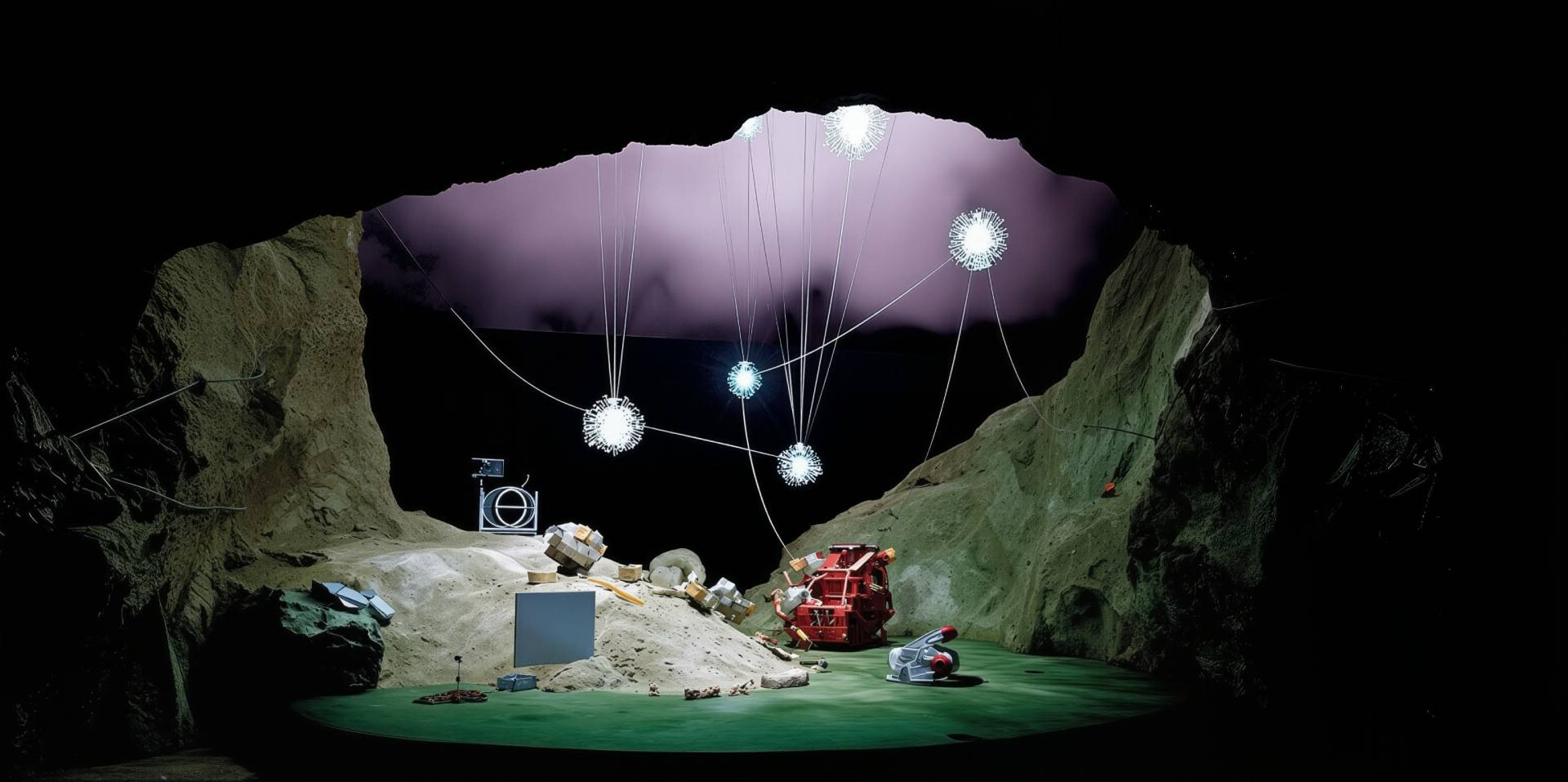
To maintain coherence across these scenarios, we developed a strict prompting structure. Each prompt begins by explicitly defining the image as a miniature set design or scenographic space, establishing from the outset that the scene is constructed rather than discovered. The main environment is then described using elements drawn directly from the texts, followed by precise instructions regarding lighting, camera position, and rendering qualities. High resolution, photorealism, and oversaturated color were treated not as stylistic flourishes but as integral components of the image’s artificiality, reinforcing its status as an object rather than a window. Equally important were the exclusions: the deliberate absence of logos, readable text, or explicit references that might anchor the image too directly to existing brands or narratives.
Reference images were incorporated into the generation process as stabilizing constraints. They helped maintain a consistent aesthetic language across different scenarios and, in some cases, enabled the introduction of specific material details. Over time, this produced a visual field in which individual images could differ significantly in content while still registering as part of the same system.
The images were then pushed beyond their initial flatness through the generation of depth maps using ComfyUI. By extracting depth information from the AI-generated outputs, each image was transformed into a simulated three-dimensional space in which proximity and distance could be calculated rather than implied.
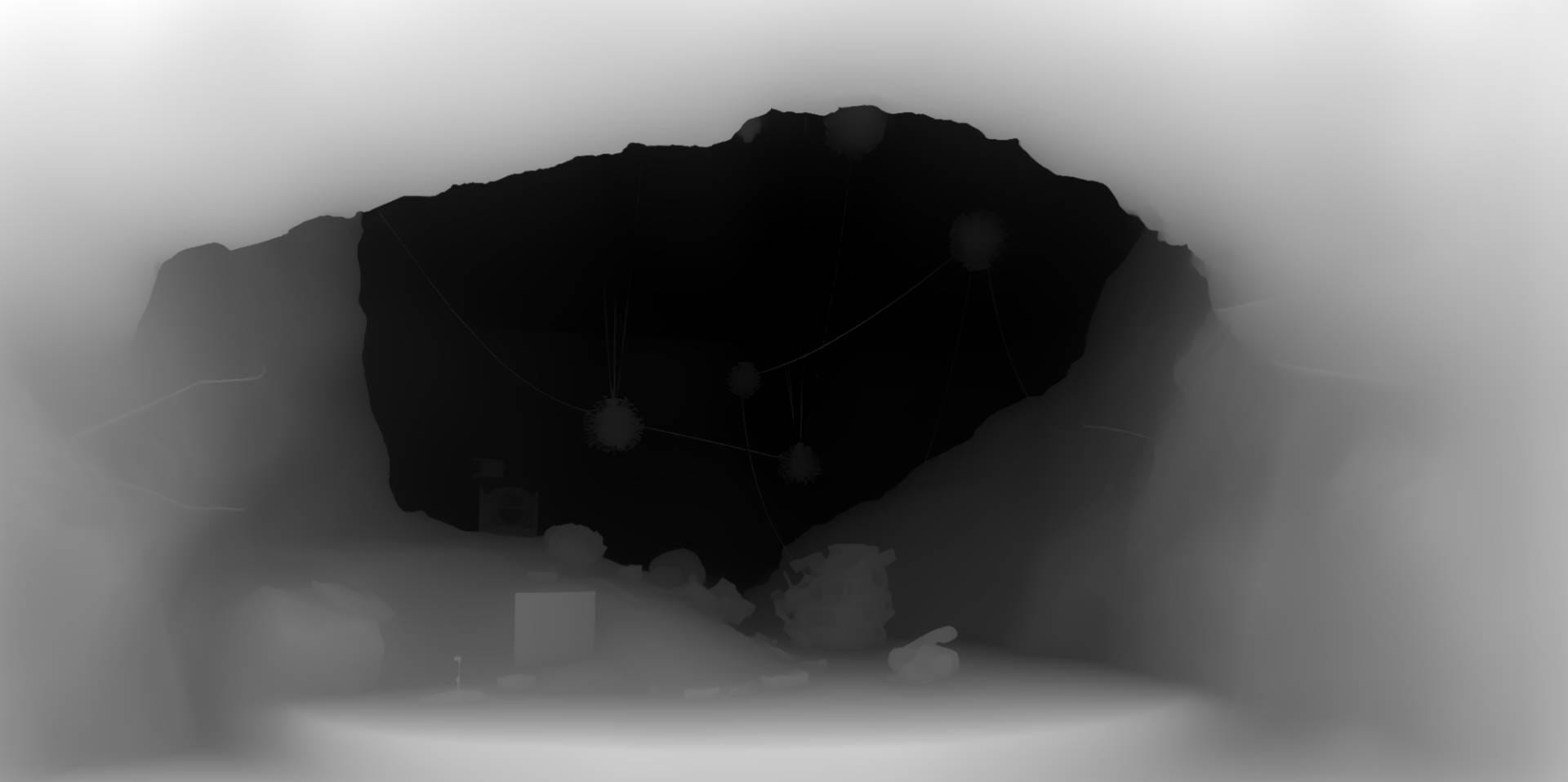
Interaction is mediated through a shader that integrates luminance, depth, and cursor position, reconstructing the scene as a field of points rather than a static surface. Within this space, the viewer’s cursor functions as a moving light source, illuminating areas of the image based on proximity while allowing others to recede into shadow. The interaction does not reveal the scene in its entirety, but instead produces a partial and contingent form of visibility, where clarity is localized and temporary. In the final stage, color is applied through linear blending, giving each scenario a distinct chromatic orientation without relying on symbolic cues.
What Hockney and Falco describe as secret knowledge was never simply about the use of optical devices. It was about a shift in where vision is located. The camera obscura did not merely assist the painter; it reorganized seeing itself, redistributing perception across surfaces, instruments, and spaces. Vision became something that happened inside an apparatus rather than in the eye alone.
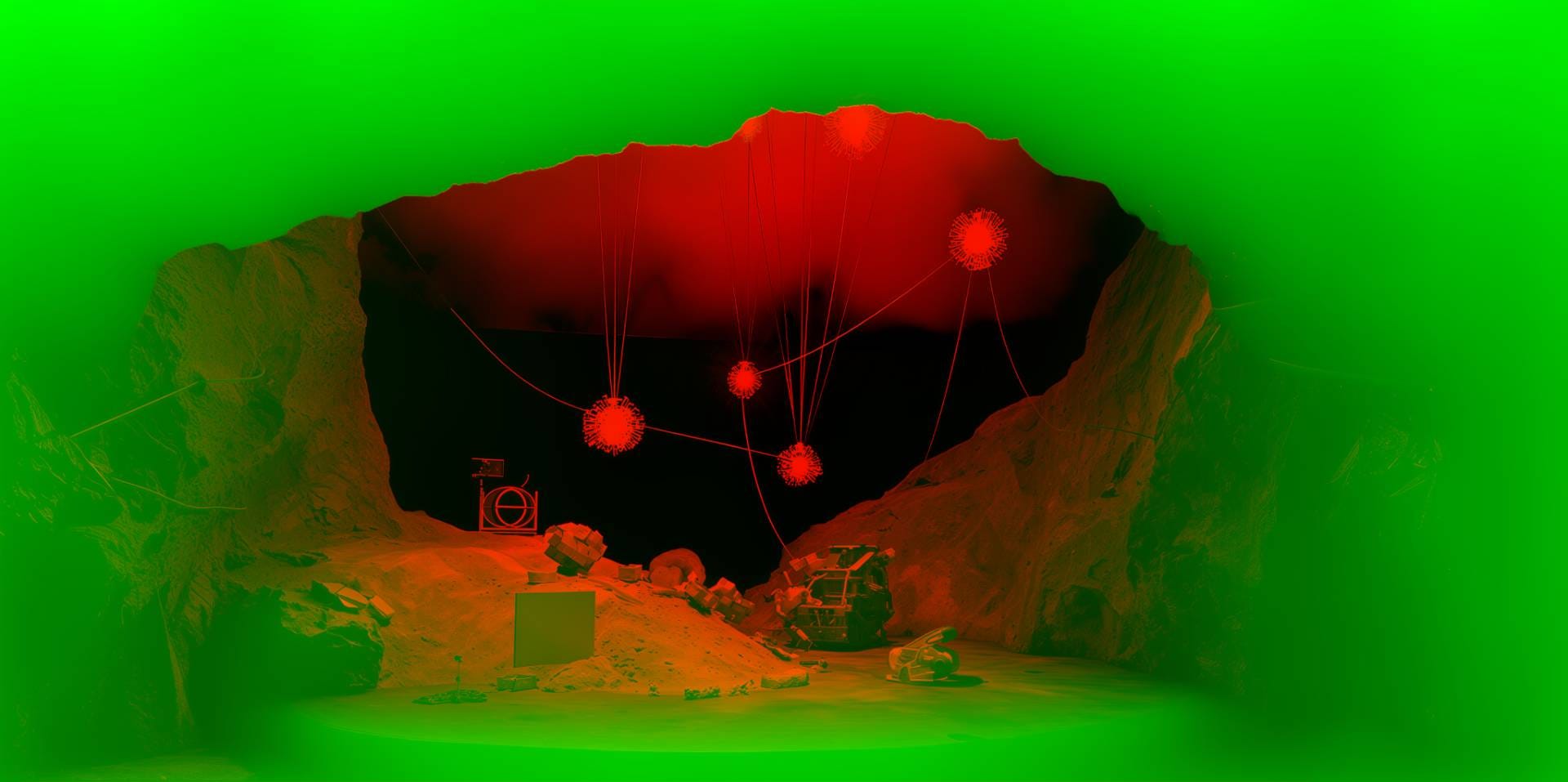
Read through this lens, generative AI functions less as a novel medium than as a contemporary camera obscura: not a tool that produces images on demand, but an environment in which images already exist in latent form, awaiting extraction, manipulation, and staging. What appears as automation is, in fact, a relocation of agency—from the visible gesture of making to the opaque operations of systems trained on vast, ungraspable datasets. The “secret” is no longer optical precision, but statistical plausibility; no longer the mirror or lens, but the model and its weights.
This is where the Stack re-enters the image—not as an abstract diagram, but as a visual condition. The hemispherical stacks described by Antikythera are themselves camera obscuras at planetary scale: layered enclosures that capture, process, and project reality through computation, logistics, and power. Data regimes, orbital infrastructures, semiconductor supply chains, and AI models do not merely support images; they determine what can be seen, how it can appear, and under what conditions it becomes legible.
The images developed for Hemispherical Stacks do not attempt to illustrate this system from the outside. Instead, they stage it. Each scenario operates simultaneously as a set, an image, and a diagram of its own construction. The miniature environments, exaggerated lighting, and overt artificiality insist on their status as tricks—assemblages designed to be looked into rather than through. In this sense, the images reflect not only the logic of the Stack, but also the logic of the camera obscura itself: enclosed spaces where external forces are reorganized into controlled visual phenomena.
The final interactive layer completes this circuit. By fragmenting visibility through depth, thick fog, and cursor-driven illumination, the images refuse total access. Seeing becomes local, contingent, and time-bound. What is revealed is always partial, while the rest recedes into infrastructural darkness.
Taken together, the project treats AI generation, planetary computation, and image-making as variations of the same problem: how vision is mediated, constrained, and staged by systems that exceed individual perception. If the early modern painter stood inside the camera obscura to redraw the world with uncanny accuracy, the
contemporary image-maker stands inside the Stack, extracting visions from a computational interior whose boundaries are difficult to locate and impossible to fully see.
In this sense, our take on Hemispherical Stacks is that it stages the present as an enclosed space from where to operate: one in which images do not represent reality, but the pipeline deployed for its construction.
Read more on Hemstacks from Nicolay in this piece.
Hope you enjoyed :)
If you want to learn more about upcoming projects from Giga you can also follow us on Instagram and check our website.